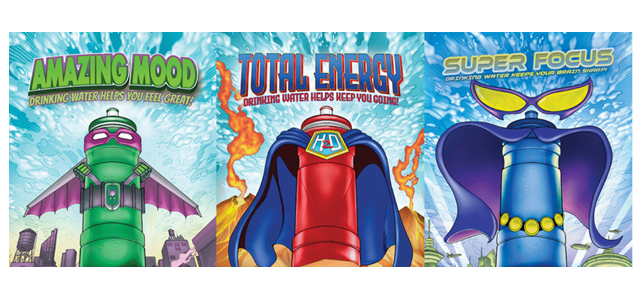
 In the halls of a large Virginia school district, a league of “Water Heroes” is making a splash. They aren’t flying through the air; they are living on water bottles and posters, reminding students that hydration is the key to a sharp mind, a healthy body and strong teeth.
While the vibrant “Focus, Mood and Energy” superheroes capture the students’ imaginations, they are the result of a multi-year effort to bridge clinical care with community health. Leading this charge is Melanie Bean, Ph.D., a professor in VCU School of Medicine’s Department of Pediatrics and behavioral scientist at CHoR. As co-director of our Healthy Lifestyle Center and a lead for the C. Kenneth and Dianne Wright Center for Clinical and Translational Research, Bean understands that clinical solutions must reach children where they spend the majority of their time: in school.
From a ripple to a wave: Scaling the research
The project was originally sparked when the school district approached Bean and her team of investigators and partners, including Fit4Kids, with a puzzle: the district had passed a model hydration policy and had invested in high-tech hydration stations, but there were persistent barriers to optimizing this policy and environmental investment.
These weren’t just theoretical problems; they were practical, “on-the-ground” challenges. A needs assessment found a lack of reusable bottles, concerns over how to keep those bottles clean and maintenance issues like missing floor mats or stations that had been turned off.
To tackle these hurdles, a multidisciplinary team of experts—bringing the same spirit of “team science” that Bean champions in her leadership role at the Wright Center—stepped in to tackle these barriers. The team included Jessica LaRose, Ph.D. and Sonya Hung, Ph.D., from the Department of Social and Behavioral Sciences in the VCU School of Public Health and Alisa Brewer from VCU’s Center on Health Advancement. Together with Justine Blincoe, policy coordinator for Fit4Kids, and a dedicated cohort of postdoctoral fellows and clinical research coordinators, they recognized that the school is a critical environment where small, daily choices can be transformed into lifelong health habits. This early collaboration eventually secured a major NIH R01 grant to fund a 5-year study designed to maximize water access and health outcomes across the district.
The path to this major NIH grant began with critical pilot funding from the Child Health Research Institute and Children’s Hospital Foundation. These early investments enabled Bean to join forces with a longtime collaborator, Tegwyn Brickhouse, D.D.S., Ph.D., professor in the Department of Pediatric Dentistry and Dental Public Health and Policy at the VCU School of Dentistry. “I was so glad Teg agreed to join us on this project. With her expertise, we were able to combine behavioral science with dental public health in a community setting, and that was just what this project called for,” Bean said.
“When we talk about interdisciplinary research, team science and research that makes a real-world impact right away, this project is really a prime example,” Brickhouse said.
A deep dive into community partnership
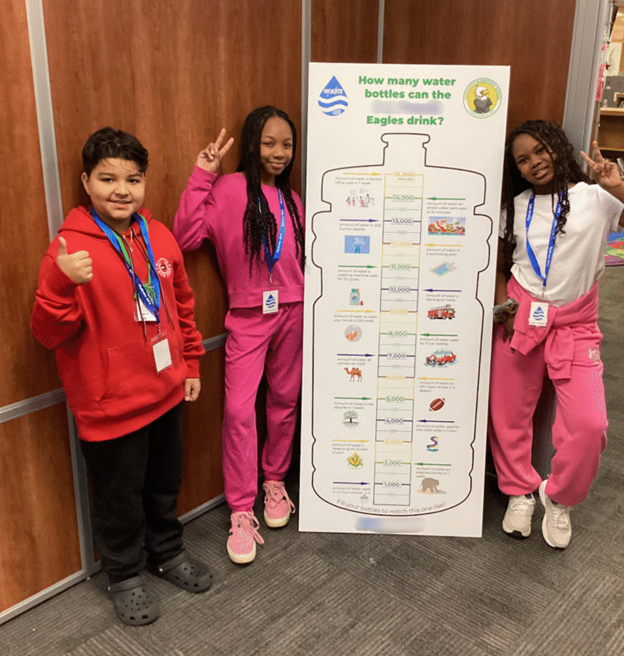 Central to the project’s success is a model known as community-based participatory research, where community members are treated as equal partners rather than just subjects of a study. The team utilized methods consistent with those promoted by the Wright Center’s Community Engaged Research core. Part of this approach was building capacity through the appointment of teacher and student hydration ambassadors.
These peer leaders serve as “intervention champions” within their schools. By empowering those who are in the buildings every day, the project builds a self-sustaining culture of health. These ambassadors don’t just promote water; they provide vital “user-experience” feedback that has led to real-time improvements, such as identifying the need for more durable water bottles and establishing better cleaning protocols. Bean knew from her clinical experience that behavioral change—like choosing water over sugary drinks—only sticks when the community has a “seat at the table.”
“Your community knows itself best,” Bean says. “They are true partners that are invested from the start.”
By establishing a community advisory board of parents, teachers, school nutrition personnel and students, the team ensured the study addressed real-world barriers like water bottle access, cleaning and storage, in ways that are feasible for the district. The community advisory board continues to inform all aspects of this work and has been meeting quarterly for 5 years. This partnership, which includes the local non-profit Fit4Kids, bridges the gap between academic research and policy to improve health outcomes for all families.
Making a splash: Making water the “cool” choice
To ensure the messaging truly resonated, the team looked to the students themselves to lead the creative process. The project hosted collaborative brainstorming sessions with students and advertising consultant John Szalay, which led to the development of the “Heroes vs. Villains” theme. Through this partnership, they dreamed up the Water Heroes—officially named The Crimson Wave, Hydro Flash and Aqua Guardian. Once the narrative was established, graphic designer Eric Serviss stepped in to make it all come to life, creating the vibrant visuals that now represent the program. Each hero possesses powers fueled by focus, mood and energy, standing in stark contrast to a group of villains known as the Cavity Queen, Daze and Heatwave, who represent the sluggishness and health risks caused by sugary drinks.
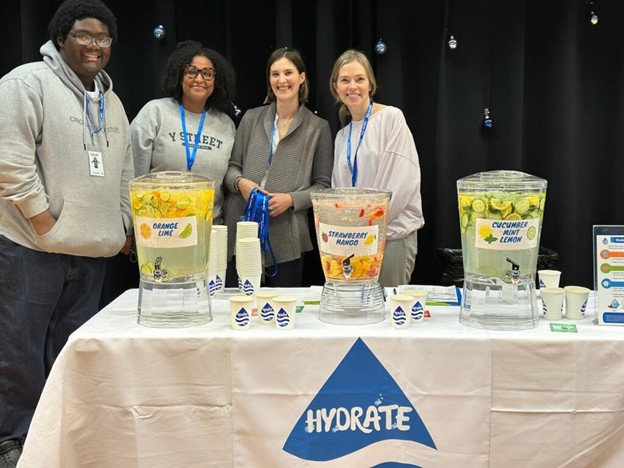 This storytelling came to life during “kick-off” events featuring fruit-infused water taste tests and “water swag” donated by the Virginia Foundation for Healthy Youth, including silly straws, water recipe magnets and color-changing cups. Students experimented with flavor combinations like strawberry-watermelon and apple-cinnamon, discovering that healthy hydration could be just as exciting as sugary alternatives. Students received and personalized refillable water bottles that stay at school, to ensure consistent access to the hydration stations.
Children’s Hospital Foundation played a pivotal role by donating over 10,000 high-quality reusable water bottles, responding to community feedback that earlier bottles were breaking, and more durable bottles were needed to last the school year. To further support the schools, the Virginia Foundation for Healthy Youth provided Igloo coolers and water dispensers, while Bean secured additional supplies through a grant from the NASCAR Foundation.
Measuring outcomes: Beyond the bubbler
Another key part of this initiative is evaluating its impact on long-term wellness across the school district’s 12 Title I schools. The researchers are assessing school-wide water usage from the hydration stations (measured with flowmeters) as well as how the intervention supports healthy weight through body mass index measurements and dental health tracking. Notably, this combined focus on weight and oral health was not chosen at random; it emerged directly from the priorities and concerns identified by the community advisory board during early partnership sessions.
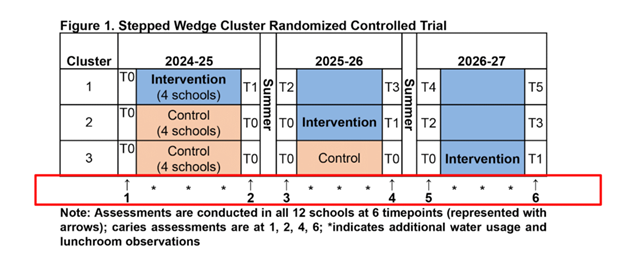 When the team recognized that an evaluation of this scale required a strong statistical framework and study design, Bean turned to the expertise of her colleagues at the Wright Center, study investigator Roy Sabo, Ph.D., and senior biostatistician Amanda Robinson. Sabo—a professor in the Department of Biostatistics, who serves as co-lead of the Wright Center’s Resources and Services Core alongside Bean, and leads the Biostatistics, Epidemiology and Research Design (BERD) core—brought vital expertise that informed the study’s “stepped wedge” design. This rigorous method involves clusters of four schools being exposed to the intervention each year over a three-year period.
By conducting assessments across all 12 schools at every time point, the team can accurately test the intervention’s effectiveness and its long-term sustainability. This focus on sustainability is paramount; as Bean explains, “We are focused on strategies to sustain this healthy hydration culture long after the research is over.” Crucially, the team is also evaluating academic performance. Because adequate hydration is linked to improved fine motor skills and visual attention, the study examines whether better-hydrated students demonstrate improved focus and cognitive scores in the classroom.
While the primary five-year study is still processing data, and reporting specific water usage, survey results and bottle usage back to each participating school, an earlier pilot project already demonstrated promising results. The pilot study conducted in two schools (one intervention and one control) and funded by the Child Health Research Institute found that students were 10 times more likely to have water bottles at lunch than they were before the intervention. As the project continues to scale, these initial process metrics provide a promising blueprint for the future of pediatric health, showing that when science meets community creativity, the results are truly refreshing.
By Christopher Richmond
The C. Kenneth and Dianne Wright Center for Clinical and Translational Research at VCU is part of a premier national network of institutions dedicated to accelerating the transformation of scientific discoveries into lifesaving treatments for patients. Research supported by the Wright Center has grant funding from the National Center for Advancing Translational Sciences (UL1TR002001 and UM1TR004360).