
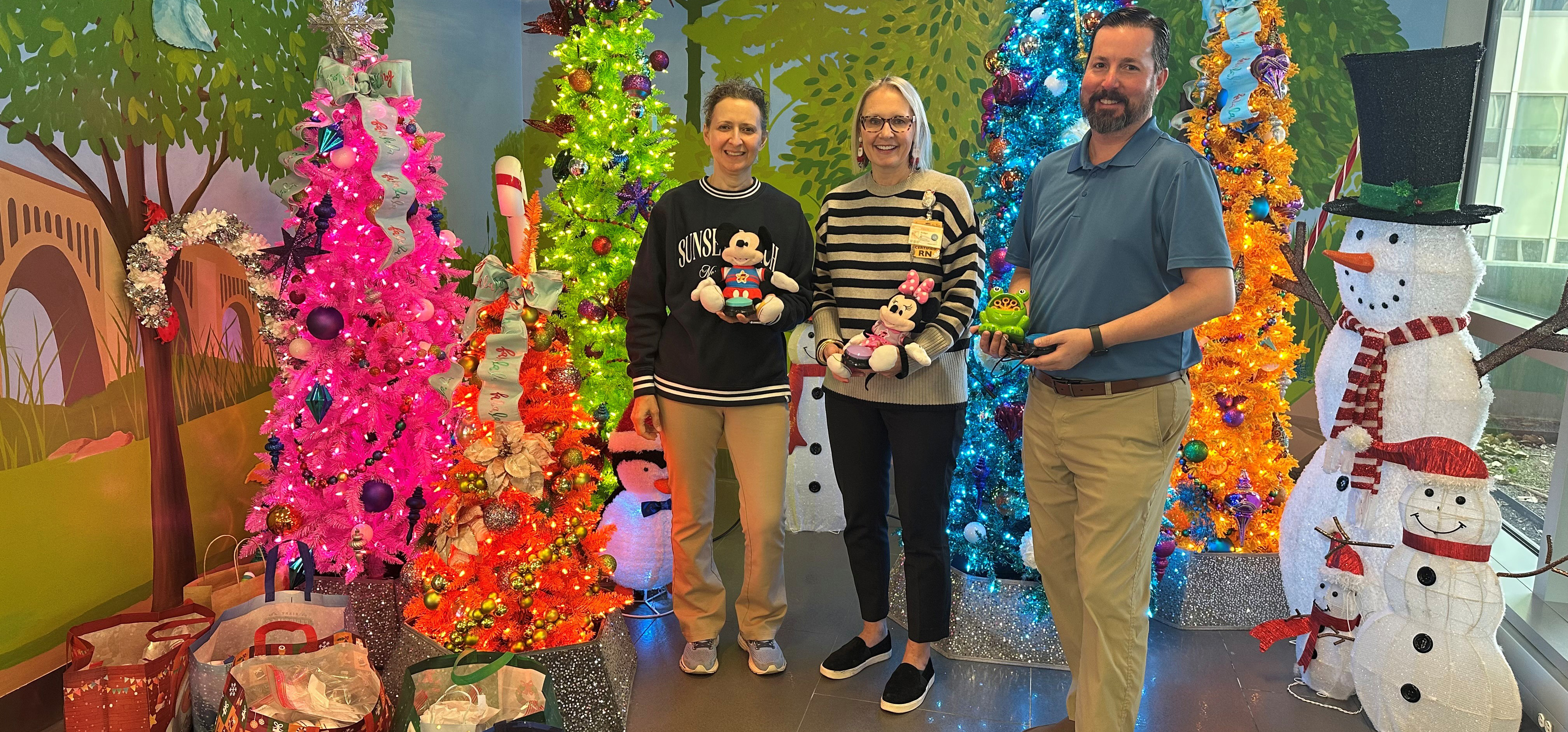
With her son Joshua as her inspiration, Monika Thrower is making switch adapted toys accessible for children
What was your favorite toy as a child? You may even remember the exact birthday or holiday you received it, and the hours of fun that followed. Every kid deserves that joy – and mom Monika Thrower has teamed up with the VCU College of Engineering to help make it happen.
Monika’s son Joshua, a long-time CHoR patient, was born prematurely and diagnosed with Phelan-McDermid Syndrome as well as developmental and physical disabilities. Now 14 years old, he’s had a limited number of toys he can interact with in a meaningful way throughout his childhood.
“About 4 years ago, I started looking into adaptive toys that would allow children with disabilities to participate in play,” said Monika. “The ones that were available were very expensive and not covered by insurance. That was when I decided to turn to our wonderful community to see who would help adapt toys to make them accessible and affordable.”
A meeting of the minds to make toys of all kinds
It was almost 2 years later when Monika reached out to the VCU College of Engineering and was connected with Dr. Michael Cabral, a professor in the Department of Electrical and Computer Engineering.
“This came to me as a potential senior design project idea and I had a team that chose it as the project they wanted to work on,” said Dr. Cabral. “I didn’t have any background in this – neither did the students. We looked online and realized adaptive toys are very expensive, but the adaptive process is not very difficult to do. The students looked at what was available and wanted to improve on them.”
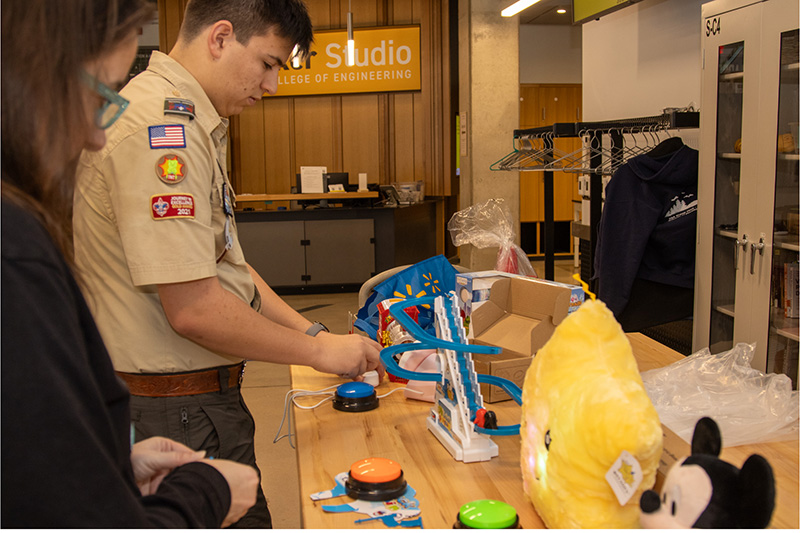 During the 2023-2024 academic year, the students – Radyah Doza, Nadia Morou and Mekeena Campbell – investigated the available adaptive toys on the market, all of which had wires that connected to a switch to make them work. For their project, they developed a wireless prototype, which allowed greater flexibility for kids who wanted to play. Dr. Cabral wasn’t content to stop there. He and his teen son, Alexander, then spent the summer taking a variety of toys apart to see how they work. As the culmination of his son’s Eagle Scout project, they planned a “hackers day,” inviting students, scouts and any other community members who wanted to join them in building something better. Radyah and Mekeena even traveled back to Richmond to help.
“We wanted to have a day where the community could come together and adapt a bunch of different toys and get them in the hands of the people who needed them,” Cabral said.
More than 50 volunteers gathered in the College of Engineering Maker Studio to adapt toys that were originally activated by flipping a small switch. Once adapted, they were all controlled with a larger external switch/button that’s easier for children to control from their chair, wheelchair or hospital bed.
A few months later, they led another hackers day with volunteers from a church group. Shortly before the holidays last year, families were invited to join in the fun.
“We not only hacked toys for the families, but we showed them how to do it so they could make their own adaptive toys for their children at home,” added Cabral.
The toys ranged from light-up Mickey and Minnie figures to a bubble-blowing frog, train, penguin racer and bead spinner for making jewelry – all controlled with the same large button remote.
“The thing I love about these adaptive toys is that Joshua is successful. He’s always been interested in cause and effect toys and this provides him with instant success. It’s been wonderful to see him having fun and engaging in play again using a variety of switch adapted toys, which allows an opportunity to explore and build essential skills through play,” said Monika. “We only had one adaptive toy before we met Michael. It was just too expensive.”
Take a peek into how the toys were adapted at the hackers day
What is a switch adapted toy?
A switch adapted toy is a toy that’s been modified to activate through a larger external switch/button. This makes the toy more accessible for children with disabilities, who have limited to no opportunities to engage in play because they are unable to activate an un-adapted toy themselves.
A mission that continues to grow
Monika and Dr. Cabral are making sure kids at CHoR can benefit from the adapted toys too. They’ve delivered dozens to our child life, therapy and complex care teams to provide for their patients.
“We’re just so grateful that our patients and families can benefit from the amazing ideas and hard work of Monika, Michael and the talented students who have figured out how to make play accessible through these toys,” said Dr. Karen Webb, associate chief nursing officer for CHoR.
And they’re not done yet! What began as a hopeful idea continues to evolve to benefit even more people who want to play.
“The first year our senior design team showed the adaptive toys could work. Subsequent teams have improved on the designs,” said Cabral. “Last year we looked at ways people who don’t use buttons could interact, and this year’s team is working on Bluetooth capability.”
One thing is for certain – more fun lies ahead.