

The 4-year-old’s family traveled 8,000 miles for a gene therapy research trial with Dr. Amy Harper.
Yug Gulati was just 2 years and 4 months old when he received his diagnosis of Duchenne muscular dystrophy, or DMD – a condition that causes muscles to grow weaker over time. It impacts movement, breathing and heart health. As his parents began researching how to best help their son, the most promising answer was gene therapy with Dr. Amy Harper at CHoR – 8,000 miles from their home in India.
Ongoing research keeps Dr. Harper at the forefront of neuromuscular care
Dr. Harper is a physician and researcher specializing in treating patients with neuromuscular conditions. This often includes participating in clinical trials to offer promising novel therapies that could slow disease progression, and help with maintaining muscle strength and mobility for longer.
“Duchenne muscular dystrophy is caused by a lack of protein called dystrophin. Inflammation in the muscle is present at birth, but our goal is to help kids before scarring occurs,” explained Dr. Harper. “When it comes to treating these patients, we’re trying to give them a mini version of the protein, called micro-dystrophin. Different companies are investigating which micro-dystrophin is functionally better and what is the best way to deliver the micro-dystrophin gene safely.”
Dr. Harper often uses a car analogy to explain this gene therapy treatment, which involves attaching the micro-dystrophin gene to different vectors, or “cars,” to deliver it to muscle cells.
Preparing to participate in a clinical trial thousands of miles from home
After connecting with Dr. Harper by phone, Yug’s parents, who were ready to go to any length, began packing and making arrangements. They arrived in Richmond in September for their son to participate in the required screening visit – a lengthy study visit which includes signing informed consent documents, labs (a lot of labs), body movement assessments, and cardiac studies to look at his heart’s physical structure and electrical activity. Yug seemed to be a good candidate, but there was one more important test to pass. This specific lab tested for previous exposure to the “viral gene car” that would be delivering the micro-dystrophin gene.
“Specific antibody tests are mandatory for participating in gene therapy. These tests are used to identify any preexisting antibodies in the system that would interfere with the viral vector or gene car’s ability to deliver the micro-dystrophin gene,” said Dr. Harper. “If Yug had those specific antibodies, he would not qualify for this study. Thankfully, he didn’t.”
Relieved and hopeful, Yug’s family settled into the apartment that would be their home away from home for the next 6 months and began working out the logistics of living in a new country.
“It’s a rigorous study. It required outpatient infusions and multiple medications to ensure gene delivery readiness. The medication calendar alone is a parental part-time job,” explained Dr. Harper. “Safety monitoring and visits are frequent, so having a Pediatric Research Unit and designated research nurses such as Megan Beatley and Sydney Gworek were essential.”
Coordinated, complex care – kid-friendly atmosphere and approach
With great preparation and anticipation, the gene therapy occurred on November 7 – in the child-friendly atmosphere of the Children’s Tower, with a full team of pediatric experts available for Yug. It was a highly coordinated, collaborative event bringing together partners in research, nursing, hospital medicine, child life, pharmacy and the study sponsor.
Megan kept everyone abreast of the process, educated the nursing team and ensured the detailed protocols were followed at every turn – an essential role as more and more intensive research studies are taking place in both the Children’s Tower and Children’s Pavilion.
“It’s a team effort on all fronts to coordinate complex pediatric research study protocols like this one,” said Dr. Harper. “My research team and I always wear our CHoR t-shirts on infusion day. Yug and his parents found out about this and purchased matching shirts for the big day.”

Continued care following gene therapy
Inflammatory complications after gene therapy can be life-threatening, so the team monitored Yug closely. Following discharge from the hospital, Yug and his family came to the Pediatric Research Unit for outpatient appointments up to three times per week. For Dr. Harper and the research and lab teams, this meant early morning and weekend visits to stay in compliance with the protocol and safely monitor Yug – but it also meant more time with this sweet patient and his supportive family.
“Yug’s parents were incredible,” said Megan. “We discovered that his mother is a talented artist, and his father is both funny and generous. They were fun, told stories, asked great questions and remained engaged throughout even the most challenging parts of the clinical trial. Yug’s parents did an excellent job navigating every detail.”
It was imperative that Yug didn’t get sick on the multiple medications that were suppressing his immunity, so his family was instructed to essentially stay in a bubble. Any illness could potentially trigger more inflammation placing him at a higher risk of complications. His parents, while understandably nervous, were calmed by Dr. Harper’s guidance.
“We were fully aware of everything that was happening, which was comforting,” said Yug’s mom, Deepti. “Dr. Harper is very caring and detail-oriented. She was available 24/7 and answered every question in detail. We felt good having so much information.”
Yug had questions of his own.
“He talks a lot and is very social and curious. The ‘whys’ don’t end,” his dad, Nitin, lovingly shared.
The team explained that the needles and medicines would help make him strong, which was just what the brave boy – who aspires to be Spiderman when he grows up – wanted to hear.
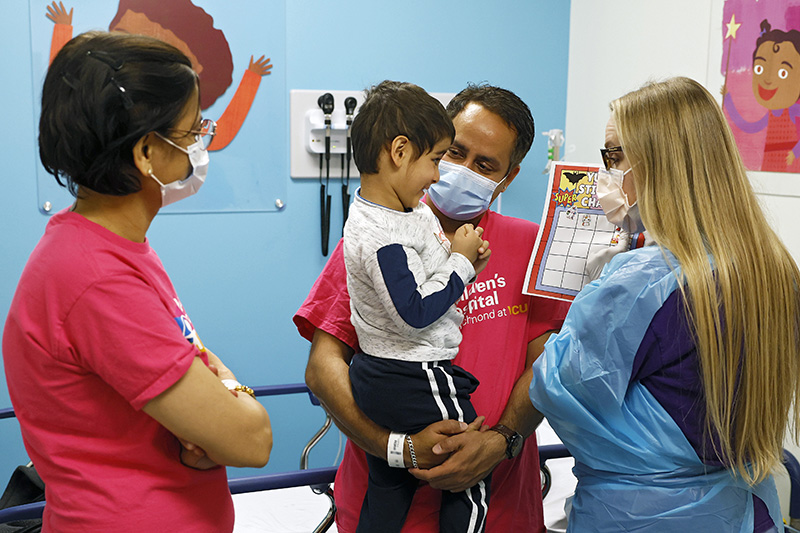 “While Sydney and I spent considerable time walking Yug through the frequent blood draws – explaining what to expect and why all the ‘pokes’ were necessary to keep him safe and healthy – we weren’t the only educators in the room,” said Megan. “Yug delighted in sharing with us, teaching us key medical words in Hindi and proudly telling us about the healthy fruits and vegetables he loves to eat.”
The nurses introduced a sticker chart as a visual way for him to see his bravery with the numerous lab draws. He especially loved the end of each week, which meant it was time to pick out a toy.
“We understood how overwhelming this experience must have been for him – a young child suddenly immersed in a different country, language and culture, surrounded by new foods, nurses, medicines, needles and masks,” Megan added.
To help him feel more in control, they also created a doctor kit filled with items he could use to practice and process what he was experiencing with a medical play duck he appropriately named Ducky.
“In our country kids are scared to see doctors, but people here make him happy. He enjoys coming, even with his fear of needles,” said Dad.
Home in India, but still close to his CHoR team
Today, 4 months after therapy, Yug is doing well. He and his parents are at home in India for a short period before returning to Richmond for their next scheduled follow-up. They’ll continue making this long back and forth journey every 6 months for the next few years so Dr. Harper and her team can keep a close eye on his progress.
“It’s been truly inspiring to witness the love, resilience and sacrifice Yug’s parents have shown in traveling across the world to give their son this life-changing opportunity. We’re grateful and honored to be a part of their story,” said Megan.