
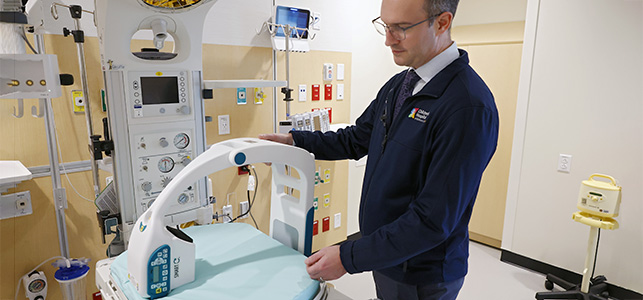
With the mini C-Arm, babies in the NICU can undergo heart procedures without leaving their rooms
Dr. Samuel Casella knows that in pediatric cardiology, the smallest details can make the biggest difference — especially when the patient weighs less than 2 pounds.
As medical director of pediatric catheterization, Dr. Casella leads some of the most delicate procedures performed anywhere in Virginia. Increasingly, that work is happening right at the bedside in the NICU, thanks to a mini C-Arm imaging system that is redefining care for our tiniest heart patients.
One of the most common challenges facing extremely premature babies is patent ductus arteriosus, a congenital heart defect in which a blood vessel in the heart that should close before birth remains open, straining the heart and lungs. For decades, treatment meant medication with mixed success or open-heart surgery that carried serious risks and potentially lifelong consequences.
That changed in 2019, when the FDA approved a minimally invasive approach to closing PDAs using a tiny catheter and occluder plug to close the opening in the heart. Guided through a blood vessel in the groin, physicians can now seal the PDA from within, eliminating the need for open-heart surgery and dramatically improving recovery. Joining CHoR in 2020, Dr. Casella has been a driving force in expanding our ability to utilize transcatheter procedures with pediatric patients, including opening a dedicated catheterization lab in 2024.
However, even with a less invasive technique, fragile NICU babies still had to be transported out of their carefully controlled environment to undergo the procedure. Transporting fragile infants out of the NICU to the catheterization lab for the procedure is complicated and time-consuming. Dr. Casella partnered with NICU leaders to evaluate the process.
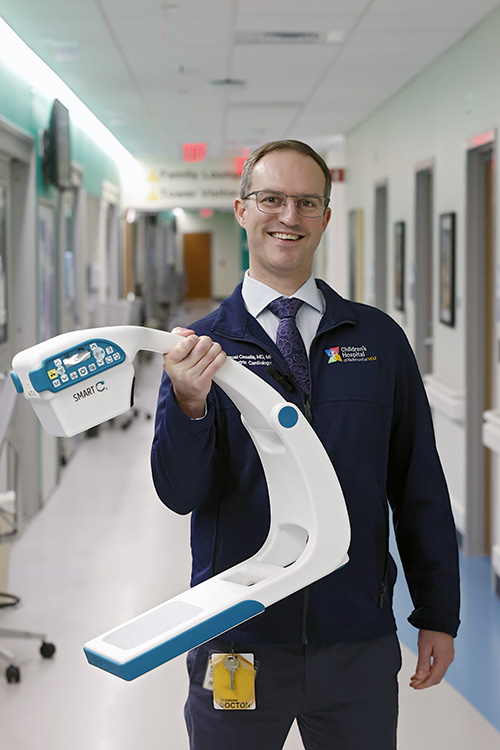 “It took nearly two hours to move a baby from the NICU to the cath lab and back — and the procedure itself took only 34 minutes,” says Dr. Casella. “For infants weighing less than 2 pounds, those extra minutes matter.”
Transporting premature babies means disconnecting ventilators, managing temperature loss and adding stress at the most vulnerable moment.
Fortunately, Dr. Casella knew of a solution – the mini C-Arm, a 16-pound, portable imaging system that provides real-time x-ray guidance and fits directly over a baby’s isolette. Acquired for CHoR’s use in 2025, it allows complex, x-ray-guided procedures to be performed safely at the bedside, eliminating risk of transport and preserving stability for fragile infants.
CHoR is currently the only hospital in Virginia using this technology, and Dr. Casella is the only physician in the state utilizing it. Outcomes match those achieved in a traditional catheterization lab, with less risk to the patient.
Dr. Casella explains how he uses the mini C-Arm in the NICU
Turning community generosity into lifesaving care at CHoR
This capability exists because of philanthropy through Children’s Hospital Foundation. A gift from Mustaches 4 Kids, a volunteer organization that raises funds for local children’s charities, funded half the cost of the mini C-Arm, turning community generosity into lifesaving care.
“It’s incredibly rewarding and unique to be able to hold the result of philanthropy in the palm of my hand and have a tangible reminder of the people who support our work every day,” says Dr. Casella.
Beyond PDA closure, the mini C-Arm is already being used to guide PICC line placement, perform angiograms and support other minimally invasive interventions across pediatrics. Dr. Casella also sees strong potential for future use in advanced therapies such as ECMO and broader surgical applications, as more teams become trained to use the technology. Each new use expands the value of the investment, turning one philanthropic gift into a platform for safer, smarter care across the hospital.
Looking ahead, Casella even envisions taking the technology into community hospitals, reducing transfers and bringing advanced care closer to home. “It would be a huge service to surrounding communities,” he says — and a natural next step in our commitment to making world-class pediatric heart care more accessible to every child who needs it.
“We’re truly bringing world-class care to the children of Richmond,” Dr. Casella says. “We are right here at your front door.”