
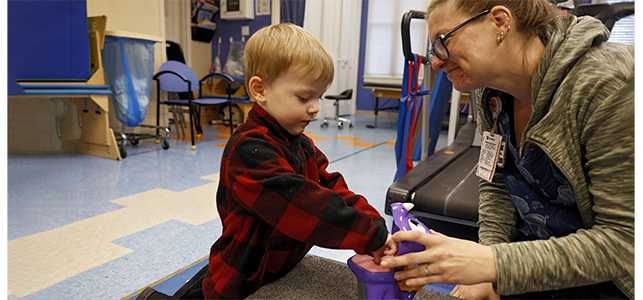
Diving deeper into play with pediatric speech language pathologists Briana Stewart, M.S., CCC-SLP and Sunshine Selby, M.S., CCC-SLP and occupational therapist Meg Dominick, OTR/L
Think back to your childhood. Maybe you remember building the tallest block towers, creating forts out of blankets or starting a band with instruments made of kitchen utensils. Or, perhaps you had a favorite toy that came everywhere with you. It wasn’t something that was overthought or scheduled out; you just did it because it was fun.
Without realizing it, you were exploring the world around you and learning through these seemingly simple activities, building foundations for skills you continue to use in your daily life as an adult. Play is something commonly used by occupational therapists, speech language pathologists and physical therapists at all of our locations, and it’s a part of a child’s everyday life.
What is play?
Play looks different in every family, culture and stage of development.
There are certain characteristics that many people agree on to describe play:
- Play is a child-directed, child-chosen activity
- The rules of the game or activity are typically created by the child
- During play, the child’s mind is active, but free of stress
- Play is imaginative and creative
- Play is engaging, motivating and sparks curiosity in a child
Briana Stewart, speech language pathologist at our Brook Road Pavilion, describes play as “a child’s exploration of objects around them.” It could be something kids do with toys bought from the store, but it can also happen with objects found around the house.
Sunshine Selby, another speech language pathologist at the Brook Road Pavilion, adds that “play is how kids interpret the world, and how they learn.”
Play is the language of a child and a crucial part of their growth.
Why is play important?
Childhood play accomplishes more than it may appear from the outside.
Meg Dominick, an occupational therapist at our Fredericksburg Therapy Center, explains that play is “how children learn best, because it’s motivating.”
When babies begin playing, they explore the ways their bodies move, helping to build muscles and stability needed to reach developmental milestones throughout childhood. As they imitate parents and caregivers, they build foundational skills for language and communication and form bonds that are important for social-emotional development.
The role of play continues to expand as children grow. Stewart adds that “play is extremely important for learning how things work and sparking curiosity, because if they are curious about things, in some way they will ask caregivers for help if they’re trying to figure them out.” She adds that play helps to introduce reciprocal interactions, which can begin with something as simple as rolling a ball back and forth, but provides the foundation for having a back-and-forth conversation with someone and other complex skills.
Dominick adds that physical skills can be developed through play, such as fine motor skills, core strength, gross motor skills and more. She emphasizes that the benefits of play do not end with language and social development. Rolling playdough, pretending to walk like different animals, tossing a ball back and forth all address skills that are needed for activities everyone does in their daily lives.
Playing with children gives us a peek into the world from the eyes of the child, which can help to understand how they see things. It’s through play that kids can start to explore many different activities, find their own interests and safely conquer their fears in supportive, low-stress environments – and when we play with them, we get a front row seat to this.
When children play with peers, they develop skills such as:
- Collaboration and working in groups
- Decision making
- Sharing
- Negotiation
- Turn-taking
- Self-advocacy
- Joint attention
- Flexibility
These are skills that are addressed through therapy sessions or tracked on developmental checklists. Our therapists agree that play can be a great way to continue honing the skills they’re working on in therapy at home because they don’t feel like they’re “working,” they’re just having fun!
How can you support a child when they’re playing?
As a parent or caregiver, there’s a lot on your plate already.
Selby suggests looking for opportunities in your daily routine. “If your child takes a bath or if you’re sitting in the car line with one kid waiting for another, you can turn these moments into playtime. You can be looking behind you while you’re parked singing a song. Just finding little pockets of time where you can just play with your kids.”
Dominick adds that you should “get down on the floor with them, be on their level, see how they see things and build from there.”
Stewart suggests even ten minutes of uninterrupted, quality one on one time playing with your child each day, following their lead is “golden,” and that the relationships formed through play are “extremely unique.” She emphasizes an environment where pressures to perform are removed, and everyone is just having fun. You can also invite siblings to join in playtime. These are powerful interactions.
Common misconceptions about play
- MYTH: Play is not productive.
It’s actually the opposite. As Stewart explains, “a child’s whole job is to play because they learn everything through play and experiences.”
- MYTH: There’s a “right” and “wrong” way to play.
This is kind of like saying there’s one right way to paint a picture. Kids play in many different ways, all of which can be beneficial for skill building – and have a powerful end result.
- MYTH: Screentime can replace play with others.
Dominick emphasizes that play should be encouraged in a way that allows children to manipulate objects and play with physical items, which can tap into sensory systems, emotional systems, and can positively affect many parts of a child’s developing brain. Selby adds that no one in a video or on a screen can teach your child better than you, and it’s important for them to have that play with another person to continue learning and developing, especially with language. While there is a place for screentime, it cannot replace the meaningful interactions experienced during face-to-face play.
- MYTH: Your children need the fanciest, most up to date toys.
You don’t need to go out and spend a ton of money on toys; you most likely already have the tools at home already to help your child engage in creative play. This could be something like using pillows or couch cushions to create an obstacle course, bubbles, filling a bowl with water or a box with toys or so many other things.
Setting up a play environment at home
Creating an environment for play doesn’t have to be complicated! Our therapists suggest a few simple strategies:
- Less is more!
- Too many options in a play space may lead to a child quickly bouncing from one activity to the next. Decluttering the space or rotating toys can help children stay engaged longer.
- Variety! Offer a good balance of toys that require imagination and toys that make noises or “do it for” the child
- Be creative! Kids will find a way to play and explore anywhere if you follow their lead.
- Safety is key!
- If you have a small child, make sure it’s a safe place that’s babyproofed and that toys aren't too small, which could pose a choking hazard.
Play may look simple from the outside, but it truly is one of the most powerful tools for children’s learning and development.
Play with a purpose is often key to successful therapy. Learn more.
By Hannah Drake, OTS with contribution from Briana Stewart, M.S., CCC-SLP, Sunshine Selby, M.S., CCC-SLP and Meg Dominick, OTR/L
References
- American Academy of Pediatrics., & Films Media Group, film distributor. (2016). The Importance of Play in Promoting Healthy Child Development [Video recording]. American Academy of Pediatrics. https://fod.infobase.com/PortalPlaylists.aspx?xtid=114579&wiID=17151
- Ginsburg, K. R., and the Committee on Communications, and the Committee on Psychosocial Aspects of Child and Family Health. (2007). The Importance of Play in Promoting Healthy Child Development and Maintaining Strong Parent-Child Bonds. Pediatrics, 119(1), 182–191. https://doi.org/10.1542/peds.2006-2697
- Gonzales, G., & Rakowsky, A. (2022). The Importance of Play. Pediatrics in Review, 43(9), 481–482. https://doi.org/10.1542/pir.2021-005148
- HeadStart. (2024, April 1). Importance of play in early childhood. https://headstart.gov/curriculum/article/importance-play-early-childhood
- Tanta, K.J., & Kuhaneck, H. (2020). Assessment and Treatment of Play. In J. C. O’Brien & H. Kuhaneck (Eds.), Case-Smith’s occupational therapy for children and adolescents (Eighth ed., pp. 239-266). Elsevier.
- Parham, L. D., & Fazio, L. S. (2008). Play in occupational therapy for children (2nd ed.). Mosby Elsevier.
- The American Occupational Therapy Association. (2018, May 8). Make play an important part of your family’s day: Occupational therapy can help [Video]. YouTube. https://www.youtube.com/watch?v=V-FwybpoI0w