
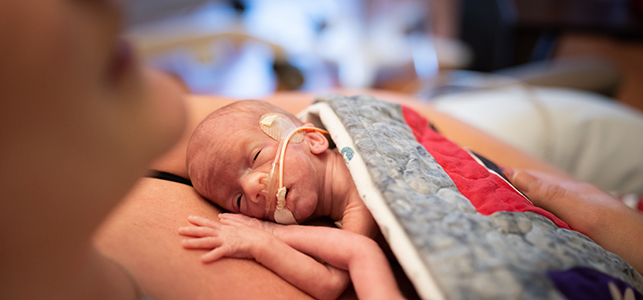
Part seven of a series introducing the passionate health care team behind CHoR’s growing Level 4 NICU
Psychologist Dr. Allison Williams has a unique role on our neonatal intensive care unit team. While her colleagues specialize in providing care for their petite patients, she supports parents and caregivers as they adjust to an often unexpected beginning to life with their new family member. Her work turned particularly personal when she became a NICU parent herself.
Dr. Allison Williams shares how psychological support for parents is an essential component of care in the CHoR NICU.
 How long have you worked in the CHoR NICU?
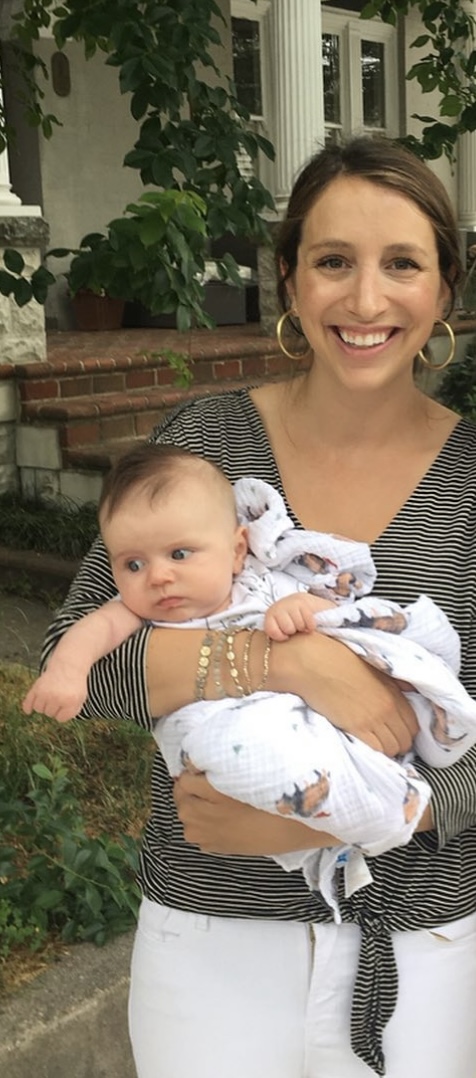
I’ve spent the past 4 years working as a clinical psychology attending in the NICU, after completing two years here as a psychology resident and writing my dissertation on posttraumatic stress in NICU parents. Very early in graduate school, I realized I wanted to become a perinatal psychologist, and that clarity shaped my training in perinatal mood, traumatic stress, early childhood development and health psychology. Along the way, I had my own unexpected NICU admission with my first child (baby Gus, pictured here!), an experience that changed me both personally and professionally. It deepened my empathy, sharpened my purpose and strengthened my commitment to supporting families through one of the most vulnerable moments of their lives.
Why have you stayed this long?
The team! We have a highly motivated and genuinely fun group of providers, nurses, therapists and psychosocial team members who make each day collaborative and energizing. I’m continually inspired by the resilience of both our families and our team, especially during the most challenging moments of a NICU admission.
I also love the fast-paced nature of the unit and the flexibility it gives me to meet families where they are. I also like wearing different hats as a researcher and mentor. The work is varied and deeply rewarding, and made even more meaningful by an incredible team and a highly motivated patient population.
What does your current role entail?
I do a mix of clinical work, research and teaching in the NICU and in the Neonatal Continuing Care Program. In the NICU and for mothers on antepartum, I provide assessment and treatment of perinatal mood concerns (e.g., depression, PTSD and anxiety) using evidence-based treatment, with the goal of supporting parent–infant bonding. In this role, I also encourage developmentally sensitive caregiving, help parents navigate difficult medical decisions and celebrate their babies’ successes.
My current funded research examines the relationship between perinatal mood concerns and parent engagement in developmental care such as skin-to-skin and provision of breastmilk, with a focus on underserved patient populations and health disparities. Finally, I have the opportunity to train and mentor a range of students, including psychology residents and medical students, as well as conduct specialized in-services on topics like perinatal mood and trauma-informed care.
Is there a moment in your career that stands out to you as being extra special?
One of the most special parts of my work is witnessing moments in a NICU family’s journey that feel almost sacred. A favorite is when a mother holds her baby skin-to-skin for the first time. I’m often there to help ease her anxiety around the wires and fragility, and watching her settle into her baby as they co-regulate is indescribable. Many parents say they initially feel more like visitors than parents in the NICU, so any moment that empowers them is meaningful to me.
I also love our discharge parades—pompoms, the graduation song and a hallway full of cheering staff. In those moments, I think about how far a family has come, often from before delivery through some of their hardest days, to the milestone they’ve been dreaming of. Being present for their resilience during such a difficult chapter is a privilege I never take lightly.
What do you hope families in the NICU take away from their interactions with you?
I hope families leave our interactions feeling supported and empowered. Every family who enters the NICU experiences some form of loss—whether it’s the birth they imagined, the newborn period they hoped for, or, in some cases, the future they had envisioned for their child. At the same time, they’re also experiencing one of the greatest joys of their lives: becoming a parent and welcoming a new, precious baby. Holding both of these truths at once is important.
I hope to help parents recognize that their mental health matters, and that caring for themselves—especially when navigating perinatal mood concerns—is an essential part of caring for their baby. I also want them to feel confident in understanding their baby’s cues and to see their baby as a baby, not a patient. Supporting that early connection and helping them feel grounded in their role as parents is at the heart of what I hope they take away.
What are you most looking forward to about the new NICU space in the Children’s Tower?
I’m excited to have the space to accommodate the medical volume and acuity our team has worked so hard to build for babies across the region. It’s also a beautiful environment, which makes such a difference during an already stressful time.
Is there anything else you’d like to share about how you care for families?
The postpartum period is the highest-risk time for perinatal mood concerns, which is why meeting families in the NICU during this window—supporting bonding, providing early treatment and prevention, and guiding them through difficult decisions—feels so meaningful. NICU psychology is my passion because it reaches some of the most underserved families at a moment when trauma, vulnerability and opportunity intersect. Families facing health disparities are more likely to experience preterm birth, and the NICU experience can compound that stress during a critical bonding period that shapes long-term development.
I would always rather meet families in the midst of these challenges than help them process everything later. Early support for attachment, mental health and safety—including postpartum mood disorders and intimate partner violence, both major contributors to maternal morbidity—is one of the greatest strengths of integrated NICU care.