
Chiari malformation
Chiari malformation
You want expertise and compassion when it comes to your child’s medical care. You’ll find that at CHoR.
We are national leaders in Chiari malformation treatment and research. Our neurosurgeons use the latest technology to treat your child and help them recover after surgery.
Dr. David Limbrick, a pediatric neurosurgeon and chair of the Department of Neurosurgery at VCU Health, is the number one NIH funded neurosurgeon in the country for Chiari malformation and has published more than 40 papers on the condition.
Whether you are traveling for care or from Richmond, Dr. Limbrick offers a virtual specialist review before your family travels to CHoR.
Start your virtual specialist review here
Request a neurosurgery appointment
What is Chiari malformation?
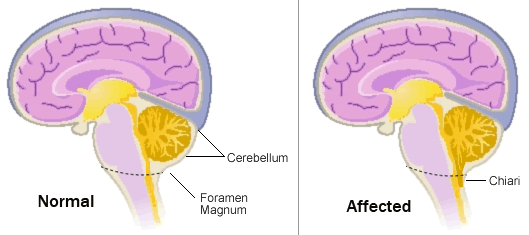
In Chiari malformation, the lowest part of the brain — called the cerebellum — pushes into the spinal canal.
We treat all types of Chiari malformation:
- Chiari 1 is the most common type and can affect infants and older children.
- Chiari 2 is most often found in children with spina bifida.
- Chiari 3 is a more rare and severe type that is often seen with a developmental problem called encephalocele.
- Chiari 4 is a rare type that usually means the cerebellum is not fully developed.
- Other types include Chiari 0, Chiari 0.5, and Chiari 1.5.
The exact cause for Chiari malformation is not known. Our team is working hard to find answers and give every child the best care.
What are the symptoms of Chiari malformation?
Symptoms of Chiari malformation in infants include:
- Breathing problems
- Difficulty swallowing or gagging
- Excessive drooling
- Irritability, especially when being fed
- Sleep apnea
- Stiff neck or head pain
- Weak cry
- Weakness in the arms and legs
For toddlers and older children, symptoms may be:
- Headaches, especially if they get worse with laughing, coughing or straining
- Back and neck pain
- Choking or trouble with swallowing
- Dizziness or balance problems
- Problems with hand coordination and fine motor skills
- Ringing or buzzing in the ears
- Scoliosis or spinal deformity
- Sleep problems or sleep apnea
- Weakness or numbness in the arms and legs
However, not all children with Chiari malformation have symptoms.
Conditions associated with Chiari malformation
Some conditions often associated with Chiari malformation are:
- Fluid in the spinal cord, also known as syrinx or syringomyelia.
- Abnormal growth of the facial bones or skull, such as craniosynostosis and other craniofacial conditions.
- Conditions affecting connective tissues. This includes hypermobility conditions like Ehlers-Danlos syndrome.
- Hydrocephalus
- Leakage of brain and spinal fluid, also called cerebrospinal fluid leak.
- Scoliosis or spinal deformity
- Spinal cord tethering
How is Chiari malformation treated?
Surgery to decompress the Chiari malformation and relieve pressure is one treatment option. Other care can include treating related issues, like spinal instability, spine fluid leakage or blood flow.
Our providers can also use MRI imaging and sleep studies to track your child’s condition.