
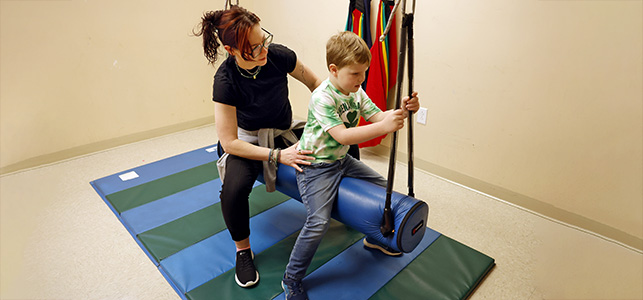
Learning about emotional regulation with pediatric speech language pathologist and pediatric occupational therapist, Briana Stewart, M.S, CCC-SLP and Marta Parr, OTD, OTR/L.
Big emotions are feelings everyone experiences at every stage of life. Maybe without realizing it, you are practicing emotional regulation, which is a skill that begins to develop in childhood and helps shape relationships and engagement in everyday life.
What is emotional regulation?
Emotional regulation involves many parts, which include:
- Recognizing emotions
- Understanding emotions and situations
- Managing emotions
- Responding in a way that’s appropriate and matches the situation
Briana Stewart, speech language pathologist at our Brook Road Pavilion, defines emotional regulation as “your ability to respond to the environment in a non-explosive way, or how you get through your day without feeling totally drained and trying to mask everything all the time.”
Emotional regulation is crucial for many parts of life because it helps support relationship building and working through difficult things.
Marta Parr, an occupational therapist at our Petersburg Therapy Center, says, “Emotional regulation is an important skill because it allows a person to experience the wide range of human emotion in a healthy way without it impacting daily tasks.” She adds that it “is the foundation for learning.”
Realistically, no one is perfect. Everyone responds to things inappropriately sometimes. It is completely normal to have moments of dysregulation, and part of emotional regulation is being able to repair relationships or situations after moments of dysregulation. For kids, this is especially true because they’re trying to learn how to manage all these big emotions, and they don’t always understand why they feel the way they do.
Kids aren’t born knowing what to do with their big emotions
Kids are born with the same big emotions adults have, but they aren’t born knowing how to manage or even understand them. These are skills that take time and practice to learn, which can be done through:
- Modeling
- Modeling comes from you, peers, teachers and other people in their lives
- Playing with peers, parents/caregivers and siblings
- Play often provides natural opportunities to practice emotional regulation through turn-taking, sharing, compromise and empathy
- Naming emotions
- Discussing emotions felt by characters in movies or books can help children learn how to identify emotions
- Having a name to express how they feel can help reduce stress by helping children communicate how they feel
- Soothing/Comforting in infancy
- When children are this young, they are unable to comfort themselves, but by helping to comfort or soothe them, you are building security and trust and helping them build their own library of regulation strategies
- Practice
- With lots of practice, kids can start to learn and pre-plan for how to respond in upsetting situations
- Storytelling and reflection with a caregiver
- This can help teach a child how to label emotions and provide alternative, healthy responses
The power of modeling
Kids learn a lot by watching other people in their lives and mimicking how they feel. This could be you as a parent or caregiver, a peer, a sibling or a teacher. Their responses to different feelings or situations are no different. This can be a key teaching tool in helping your child learn emotional regulation.
Stewart discusses one specific way of modeling for your child, which involves naming your own feelings. She says something as simple as naming the emotion you’re feeling and what you’re going to do to help regulate yourself in that moment can be very beneficial.
Co-regulation is another way of modeling that can help a child build their library of strategies. This can happen when you practice self-regulating strategies with your child, but it can also happen subconsciously. Has your child ever had a tantrum, and you start to yell or heighten your emotional state, and the whole situation escalates? You and your child were experiencing co-regulation. You may have been playing off each other's emotional states. It can be difficult to help a child regulate if you aren’t regulated yourself. That being said, no one is perfect, and dysregulation happens. This is where it becomes important to model the repair piece of emotional regulation and help your child learn that side of it as well.
What to look out for
Every child is different, so there could be differing ways you may see that a child is struggling with emotional regulation. Stewart says it’s often outward responses that you’ll pick up on.
- Crying
- Tantrums
- Whining
- Shyness
- Seeming overly introverted
- Difficulty calming down when upset
- Difficulty transitioning into new contexts and environments
Stewart says, “I think a lot of times we think of it as the tantrums and the big emotional response and we look for those signs, but if it’s a kid who’s hiding behind you, doesn’t want to talk to anybody, they’re clearly having a hard time with emotional regulation.”
Stewart and Parr place emphasis on the normalcy of tantrums in childhood development. Kids are feeling big feelings in their little bodies and minds, so they need some way to express that.
Sometimes kids require a little more support to learn emotional regulation. Parr and Stewart recommend reaching out to a provider if:
- You as the caregiver or parent are having difficulty finding strategies to support your child
- Emotional outbursts or responses are consistently interrupting daily routines or daily tasks
What can you do in the moment?
Stewart has a few suggestions for helping your child through moments of dysregulation.
- Help your child name their own emotions
- Talk about options for what to do
- Breathing exercises
- Movement breaks
- Yoga
- Hugs
- If your child is having big emotions or a big tantrum, it may be helpful to say less. If they’re already in the heat of the moment, talking to them may escalate the situation. Many people are not in a place to think rationally when they are experiencing big feelings, and this is no different for children. As long as you make sure they are safe, you can circle back as they calm down or later in the day, and make sure they understand what happened and why.
Not every child is the same, so this may take some trial and error to figure out what helps your child.
Parr emphasizes that children experiencing strong emotions is normal, and there may be times where you as the parent or caregiver feel like you don’t know what to do, which is okay! “Understanding emotion is hard and can be even harder to teach.”
Stewart says a key takeaway she wants all parents and caregivers to know is that you are doing a great job. If you are seeking out these resources, having conversations with their doctors and asking questions, you are doing the right things. Just being present for your child is the biggest key in setting them up for success.
By Hannah Drake, OTS with contribution from Briana Stewart, M.S, CCC-SLP and Marta Parr, OTD, OTR/L
References
- American Academy of Pediatrics., & Films Media Group, film distributor. (2016). The Importance of Play in Promoting Healthy Child Development [Video recording]. American Academy of Pediatrics. https://fod.infobase.com/PortalPlaylists.aspx?xtid=114579&wiID=17151
- Ibrahim, M. (2025). Emotional Regulation. IntechOpen.
- Professional, C. C. medical. (2025, November 18). What is emotional dysregulation?. Cleveland Clinic. https://my.clevelandclinic.org/health/symptoms/25065-emotional-dysregulation
- Ratcliff, K., Fingerhut, P., & O’Brien, J. (2020). Mental Health Conditions. In J. C. O’Brien & H. Kuhaneck (Eds.), Case-Smith’s occupational therapy for children and adolescents (Eighth ed., pp. 746-752). Elsevier.
- Self-regulation: Emotional regulation. Illinois Early Learning Project. (2025, May 14). https://illinoisearlylearning.org/ielg/emotional/
- What is co-regulation?. Child Mind Institute. (2026, January 21). https://childmind.org/article/what-is-co-regulation/