
Getting to school safely: As the new year begins, here are important reminders for parents no matter how your kiddo commutes to campus
August 20, 2026
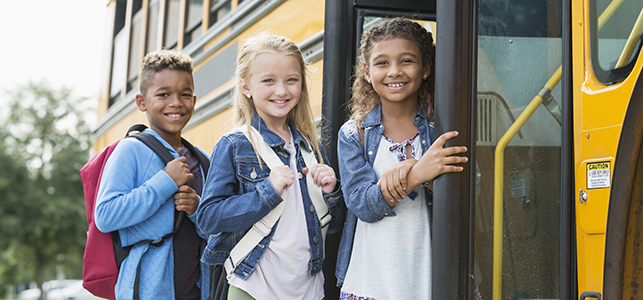
Making sure your child has all the school clothes and supplies they need is only half the battle. Corri Miller-Hobbs with Safe Kids Virginia helps us navigate the do’s and don’ts around school bus stops, walking to school and the rules around e-bikes and scooters.
What are the biggest safety concerns around school bus stops and what advice do you have for parents?
Supervision and continual safety instruction are key as children grow and gain experience.
- Teach your child to wait for the bus on the curb and three giant steps back away from the street.
- Your little one should wait for the bus to stop completely and the doors to open before approaching.
- If your child must cross the street after exiting the bus, they should take five giant steps in front of the bus, make eye contact with the bus driver and cross when the driver indicates it is safe.
- Your child should still actively look left, right and left to watch for traffic.
What tips do you have for parents whose children walk to school?
Many caregivers are not aware that children under age 10 need to cross the street with an adult. While all children are different, developmentally most kids can’t judge the distance and speed of traffic until age 10, so this should be taken into consideration.
If your child plans to walk to school:
- Before the first day, make several trips, practicing the walk with your child.
- Discuss rules of the road and challenges you see, while reviewing safe ways to handle these situations.
- Be a role model for your child.
- If your child is older, ask questions and even allow them an opportunity to teach you about safety.
- Remember the basics such as look left, right, left before crossing the street and continue looking until safely across the street.
- Only cross at corners and preferably where there is a crosswalk or traffic signal.
- Children and adults should always walk without distraction, so remember: Heads Up, Phones Down.
What should drivers keep in mind as this new school year starts?
The most important thing to remember: don’t drive distracted and slow down.
- Distractions can include looking for an item in the vehicle, eating, looking at something a passenger tries to show you or using an electronic device.
- Be alert for the unexpected, such as a child running into the lane of travel and heavy traffic with frequent stopping.
- Ensure everyone is buckled up or correctly using an appropriate car seat.
Are kids riding e-scooters/e-bikes to school these days? Is that an added safety concern?
Children are riding e-transportation devices in cities and neighborhoods across the country. It is important to note that due to the increased risk, the American Academy of Pediatrics does not recommend children under 16 years of age operate or ride e-devices.
- If you are considering the option, do your research.
- Review state laws and local ordinances to understand what is allowed.
- Review school district policies and the manufacturer’s instructions for the device.
- Not all e-transportation devices are designed for children because there are additional safety concerns. They move very fast, requiring the rider to assess situations and respond quickly. These are skills children and teens do not have yet because their brains are still developing these capabilities.
- If your child is legally able to ride an e-device and they fall within the manufacturer’s guidelines, provide safety education, monitor their behaviors and make corrections.
- Make it a requirement that your child always wears a device appropriate helmet, dresses for safety, uses a light on the device, and does not use earbuds, earphones, or their phone while riding.
- Your child should always ride solo, and they must follow the rules of the road.
What should a parent or caregiver do if they notice safety concerns around their child’s school?
- I would encourage caregivers to engage with their child’s school to address traffic safety in and around campus.
- Administrators should be open to discussion and are constantly working to facilitate traffic safety for all students.
What should parents keep in mind as the school year progresses?
- Don’t forget when the time changes this fall, children may be transitioning between home and school when it is dark outside. Add an extra layer of protection by using reflective stripes on backpacks, jacket pulls, shoes and other items to be visible in the dark.
- Discuss the need to be visible, but also actively watching for vehicles, including bicycles and scooters.