
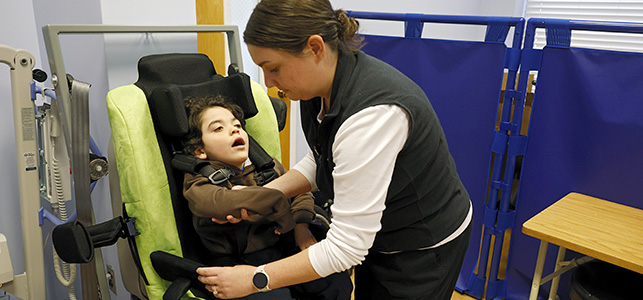
A car seat is absolutely necessary for your child’s safety, but if you have kids with medical or behavioral needs you may need extra help choosing the right seat and making sure it’s installed properly.
When does a child need an adaptive car seat?
Conventional car seats provide the best protection for most children up to a certain height and weight. Michelle Froede, physical therapist and certified passenger safety technician, says you should keep your little ones in a conventional car seat until they’ve reached the maximum height or weight limits of that seat, but more importantly, you shouldn’t be in a hurry to have your child face forward while they’re in the car.
“The continued use of rear-facing seats is strongly encouraged for as long as possible,” shared Froede. “Rear-facing seats offer the best protection in a crash by supporting the head, neck and spine, which is especially critical for young children and those with complex medical needs.”
Since there are limited options for adaptive rear-facing car seats, Froede said, “it’s important to maximize the use of conventional seats before transitioning. I always tell families, don’t rush it. If your child still fits the height and weight limits, keep them rear facing.”
Once your child reaches the maximum height or weight limits of their conventional car seat, a forward-facing car seat is needed. but if they have special needs there are certain criteria that could make an adaptive car seat necessary.
“If your child exhibits escaping behaviors or has low or fluctuating muscle tone, an adaptive car seat will help keep them safe,” explained Froede. “In addition, children who are diagnosed with conditions like cerebral palsy, muscular dystrophy, spina bifida, obesity or certain genetic disorders, may need an adaptive car seat. These seats are designed to provide additional support and security, helping children remain positioned properly and safely while on the road.”
What happens during an adaptive car seat evaluation?
“The thing we look for is correct fit, making sure we can get a snug fit of the harness and a secure fit of all the accessories,” explained Froede. “With tools, we can adjust hip guides and lateral supports to provide the most stability. Also, in a forward-facing car seat, we want to make sure the harness is at or just above the shoulders.”
It’s not just about safety and stability. Comfort is also very important.
“The headrest needs to be in the perfect position to support your child’s head and it’s important they look comfortable in the seat,” Froede said. “If there are any concerns from a respiratory standpoint and we can’t get a good fit with the harness, we would potentially consider an alternative option. That’s what’s great about our Brook Road location. We have a lot of options for different car seats, so we can try another one to see if that’s a better fit for your child.”
We offer car seat evaluations at multiple locations in addition to the site at Brook Road including our Fredericksburg Therapy Center, Stafford Therapy Center and Petersburg Therapy Center.
Going the extra mile for car seat safety
Froede, who recently became certified as a Safe Travel for All instructor, is now able to train more CHoR team members to perform car seat evaluations and be a resource for parents who may not be able to afford the equipment they need.
“We don’t just evaluate, we advocate,” said Froede. “We write letters of medical necessity, help with insurance appeals and connect families with vendors. We also look at the caregiver’s ability to transfer the child in and out of the seat, because safety must work for the whole family.”
Many families are surprised and relieved to have CHoR as a resource for this type of evaluation and are grateful for the peace of mind.
“One family that really stands out to me had a young child born with a severe birth defect,” Froede remembered. “Because of her condition, she required medical transport for every outing, and her parents were understandably terrified to take her anywhere on their own. Once we were able to get her fitted with an adaptive car seat designed specifically for children with her diagnosis, everything changed. For the first time they could go out as a family without relying on an ambulance.”
Learn more about the specific conditions that require an adaptive car seat and how to make an appointment for an evaluation.